21-February-2024. Walnut Canyon National Monument and Lowell Observatory
- claudianmurray
- Feb 21, 2024
- 6 min read
Although today started out sunny (was supposed to shower much of the day) I had to get together all my tax documents because I didn't do it yesterday ... visiting those 2 national monuments was too much fun on a beautiful day.
At noon (yes, I did get all my tax homework done) I headed out and made the short drive east to Walnut Canyon National Monument. On my way there the clouds were increasing and the wind was harsh and I thought maybe I had missed my window of opportunity to get my mile in before the rain came. To my surprise and delight a few minutes after I started descending into Walnut Canyon the sun came out - lucky me!
Walnut Canyon is a place where native tribes lived in cliffside dwellings but what makes these unique is that nature eroded a layer of sediment leaving a rock overhang and floor (and back wall too) so all the natives had to do was make some walls to separate out individual rooms .... unlike other cliff dwellers that carved out their rooms from soft rock.

The dwellings were on both sides of the canyon but were most prolific in the center where there was basically a peninsula that you can climb down 185 steps and then walk around the perimeter. The north facing side of the peninsula was cold and windy and the south facing side was warm and sunny, and each side had it's own unique vegetation. The natives used the grasslands up high to farm and hunt and the river below for water; today all the water has been diverted by the city of Flagstaff so the base of the canyon is dry. It's really interesting if you look closely at the sides of the canyon walls where you can see all the holes/overhangs where rooms are.
You really notice every one of the 185 steps when you have to walk back up them at an elevation of 7000+ feet! The crazy thing is when I got to the top I had not completed my daily mile yet and so I took a short walk along a rim trail and the bad weather came in again and started with rain and ended up sleeting and snowing on me before I got back to the visitor center. Yuck. Glad I was exploring in the brief period of good weather.






Then it was on to Lowell Observatory. I got there shortly before 3 PM and headed over to a rotunda building (which currently houses some historical artifacts) to kill time before the 3 PM tour. I nerded out on some cool calculation devices and early astral cameras.
At 3pm my guide Dylan and I concluded that I was the only one there so I got an hour long personal tour. What made it extra awesome is that Dylan is in charge of the astral photography program at the observatory and he showed me some incredible pictures he had taken and I was able to ask him all sorts of photography questions. They have a special photography experience on Tuesday nights but sadly it does not start until April - I'm going to need to come back to do that!!!!!
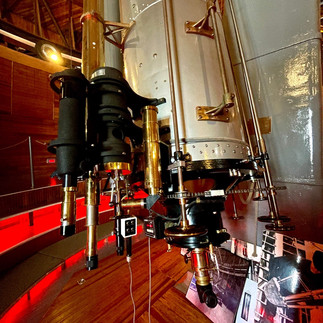
Dylan took me to the Lowell telescope which is the showpiece of the observatory. It is 126 years old and is still in use by NASA and research scientists in addition to being a telescope that visitors are able to look through on clear nights. I soon learned that structures that house telescopes are neither heated nor cooled as the telescope must be ambient temperature else condensation will form - and that windows, doors and the roof are all opened prior to the telescope being used to ensure everything is the same temperature. Considering it was a 42° cloudy and windy day (and I was dressed for indoor activities) it was awfully chilly!
The Lowell Telescope was really an incredible site to see. It is with this device that the planet Pluto was discovered! The field of view is so tiny (because it looks out so far) that it equates to the amount of sky you would see if you would hold your hand out at arms length it would be about 1/16 of your pinky fingernail - now that's a very tiny sliver of sky.
Because there were no other people on the tour, Dylan took me to the newer version of this telescope which is housed in a nearby building. Because of the system of mirrors the device is much smaller and unlike it's predecessor which is still 100% manual, you can log into the observatories computer system and control every aspect of this telescope and it's housing remotely. Even more amazing is that there is an Xbox controller laying on it and I joked with Dylan that those can't possibly be the controls – and he said that the telescope manufacturer was going to charge an extra $1000 for a controller so they just hooked up an Xbox controller. Too funny.
I had a half hour free time before my next tour so I went to the Outdoor Observatory and checked out some of the telescopes they have there. At the time there was only a thin cloud cover and so I was able to use a special telescope to look at the sun. They show a ome great close-up videos of eruptions on the sun surface - wow! There's also an interesting manual device where you can dial in the day and the time and it shows you exactly the star field that you would see above you. Never really considered it but you can't see all of the stars all of the time – the constellations are seasonal.
I attended another lecture about the planet Pluto. They are big fans at Lowell Observatory since Pluto was discovered here. The Astrologist went into detail about how they found it - literally comparing photos 6 days apart to see which specs stay in place (stars) and which ones moved (planets). Because of new scientific criteria as to what constitutes a planet Pluto was demoted to a "dwarf planet" in 2006 .... but since then more than 15 other dwarf planets have been identified beyond Pluto. We ended the tour on a walk where one sign indicated the location of the sun and every inch beyond that was 1,000,000 miles .... Pluto was about 332 feet away where a special Pluto photography telescope is located - you can't even see it in the picture below. That's crazy FAR!!!!
I ended my day by going to a program about light and colors in space - it was a bit basic but had a cool demo where the presenter made fires of different colors to draw the analogy between the colors we see when we look at nebula out in space.




My WILD (What I Learned Driving around) idea today is all about Dark Sky Cities. Flagstaff is the first officially designated Dark Sky City, Datkness is based on a brightness scale of 1 (no light pollution) to 9 (bright like LA at night). Because the observatory has been here a long time, the local community has enacted ordinances as early as the 1950s to keep the sky dark; street lights can only shine down and are low intensity (an orange wavelength versus a bright white LED). When I left the observatory I noticed the lights in the parking lot were all dim and orange, and on my way back to my hotel I looked down from the hillside over the city and noted that city lights were also all very dim and orange. The biggest source of light pollution is car headlights - which is out of their control. They say that light pollution drops off dramatically between 1 AM and 5 AM when most cars are off the road, and that brings them back to a very low dark sky rating..
Reasons this location was selected to be an observatory is that it is high up (7000'+ elevation means less atmosphere to look through), had train access to bring a large telescope close by, had a small population at the time of selection, has 300+ clear days per year, and low humidity (again less vapor to look through and less chance of water condensing on telescopes) - what an interesting day!


Love the rulers! Geeks prevail!